Stay on the path
Her First Werewolf (BBW, Werewolf, Prince Charming, Fairy Tale Romance)Stay on the path is the warning that frames Flora’s journey through the forest and gives the episode its governing tension. Spoken by her mother as Flora leaves the town, the rule appears to demand obedience and safety, yet the narrative places it beside Flora’s red cloak, her grandmother’s distant house, and the encounter with an attractive stranger whose identity is concealed until danger forces it into the open.
The Rule in Its Domestic Context
Stay on the path is issued by Flora’s mother immediately before Flora enters the woods. Her mother has sent her toward her grandmother’s house beyond the forest and up on a hillside, hoping that the comparatively wealthy older woman will help Flora obtain a dress and perhaps improve her prospects for marriage. The request is therefore not a casual errand: Flora carries an overfilled basket containing bread, jars of jam, honey, and her grandmother’s favorite shepherd’s pie, while also carrying the pressure of her mother’s expectations.
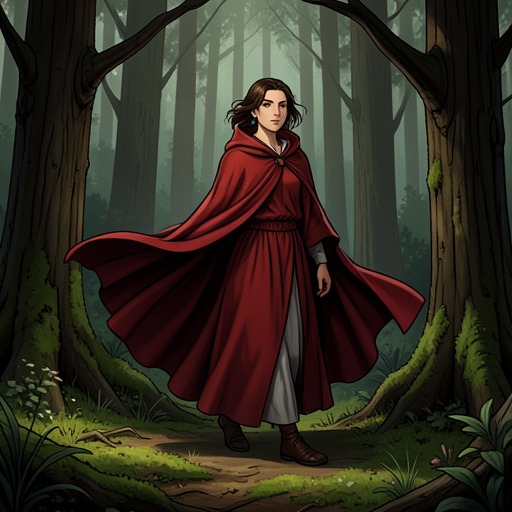
The instruction follows preparations shaped by family anxiety and social ambition. Flora’s mother gives her the red velvet cloak that has become the source of her unwanted nickname, Red. The cloak was bestowed by a trader when Flora was fourteen, after he had stayed with Flora and her mother for a time and taken more than eggs in exchange from Flora’s mother. Flora values the garment, but she dislikes being reduced to it; her real name, Flora, was chosen after field flowers. Against this background, Stay on the path governs not only physical movement but also a daughter’s passage through a world where appearance, marriage, and reputation are closely watched.
The Forest Journey
Flora acknowledges the warning as she waves to her mother at the entrance to the woods. Summer is ending, and orange and yellow-gold leaves are beginning to turn. She enjoys walking and initially treats the long journey as a welcome break from work, moving slowly enough to admire the forest, listen to leaves rustling underfoot, and watch birds and a deer. The path seems to offer an orderly route through a beautiful landscape rather than an immediate threat.
The journey becomes more psychologically charged as Flora thinks about marriage. Mary has told her that she slept with both Wilson brothers and suggested that Flora could learn about sexual pleasure by touching herself after her mother went to bed. Flora rejects that example, believing premarital sex to be dangerous and troublesome for a young woman. She does not want to become, by sixteen, a barefoot mother with a baby at her breast, nor does she want a hurried marriage to a man she does not love. Her thoughts make the path a boundary between competing futures: the prescribed route toward respectable marriage and the forbidden possibilities represented by desire and independence.
Fear, Denial, and the Stranger
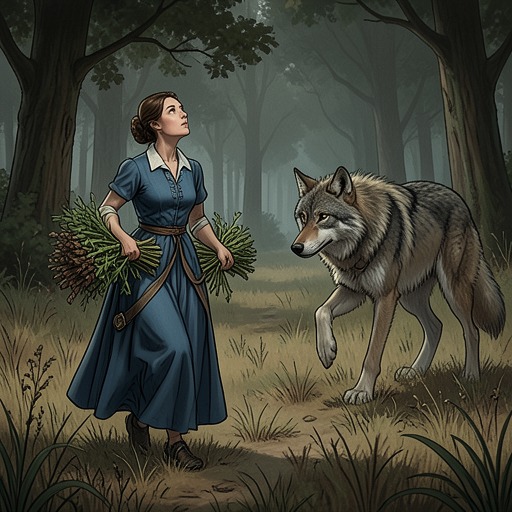
As Flora approaches the glen, the forest’s signs of safety disappear. The birds stop singing, the woods fall completely quiet, and the hair on her neck rises. Her heart beats so forcefully that she feels it in her ears, and she struggles to breathe while continuing forward and scolding herself for being afraid. To distract herself, she lists the supernatural beings she refuses to believe in, including fairies, trolls, and Werewolves. When she reaches the sunlit glen, she feels safe again, but booming laughter erupts behind her and immediately reverses that reassurance.
The man who addresses Flora appears to belong to a world outside the humble cabin and working life she knows. He is tall and handsome, with dark silky hair, green eyes, fine clean clothes, broad shoulders, and smooth skin that makes him seem unlike a farmer or herdsman. He asks where a beautiful young maid is going and steps closer, making the encounter personal before Flora has reached her grandmother’s house. The forest rule thus becomes the threshold between a supervised errand and an unscripted meeting with a stranger whose polished appearance conceals a dangerous nature.
The Rule’s Reversal and Charles’s Secret
The decisive reversal occurs when a large black, fanged snake appears behind Flora. Its bite is known to cause instant death, and Flora pulls her legs close as the snake moves toward her, believing that her life is ending. Charles tells her not to move, takes up a nearby stick, and assures her that he enjoyed their time together. Instead of using the path or ordinary human means to protect her, he changes before her eyes from a man into a large black-furred Wolf.
In Wolf form, Charles eats the twenty-foot snake in a single bite. The transformation turns the earlier warning into an irony: the danger Flora was told to avoid is not the only danger in the woods, and the apparently threatening stranger becomes her immediate rescuer. Yet the rescue does not restore ordinary safety. The emerald glow in the beast’s eyes remains kind and familiar, allowing Flora to recognize Charles even after his body has become something impossible. Charles then reveals through his voice inside her head that he is ashamed to be a Werewolf. The path’s apparent moral simplicity therefore gives way to a more difficult distinction between outward appearance, hidden identity, and actual action.
Narrative Significance
Stay on the path directly invokes the Little Red Riding Hood motif through its combination of a red garment, a mother’s warning, a forest route, a grandmother’s destination, and a strange Wolf-linked male figure. The episode reworks the warning rather than merely repeating it. Flora is not presented as a passive child moving toward a fixed moral lesson; she is a young woman already questioning marriage, sexual rules, and the future chosen for her. Her movement through the forest places those questions beside fear and attraction.
The rule also organizes a clash between social regulation and experience. Flora’s mother wants her to secure help for a dress and perhaps move toward a suitable marriage, while Flora feels uneasy about asking her grandmother for money and resists marriage without love. In the forest, the instruction to remain on the prescribed route encounters a stranger who embodies concealed difference and a supernatural transformation that cannot be understood through ordinary social categories. The resulting value shift is from confidence to fear, then from apparent mortal danger to rescue, followed by a deeper uncertainty about what Charles is and what the forest contains.
Rather than functioning only as a prohibition, Stay on the path becomes a recurring interpretive measure for Flora’s choices. The narrative places the rule at the edge of the woods, then tests the assumptions behind it through the glen, Charles’s approach, the snake attack, and the revelation of his Werewolf identity. Safety, obedience, desire, and danger no longer occupy separate sides of the path; they meet in the same forest encounter, where the figure who seems most unfamiliar is also the one who saves Flora’s life.